
Single vs Multi Passage Rotary Unions Explained
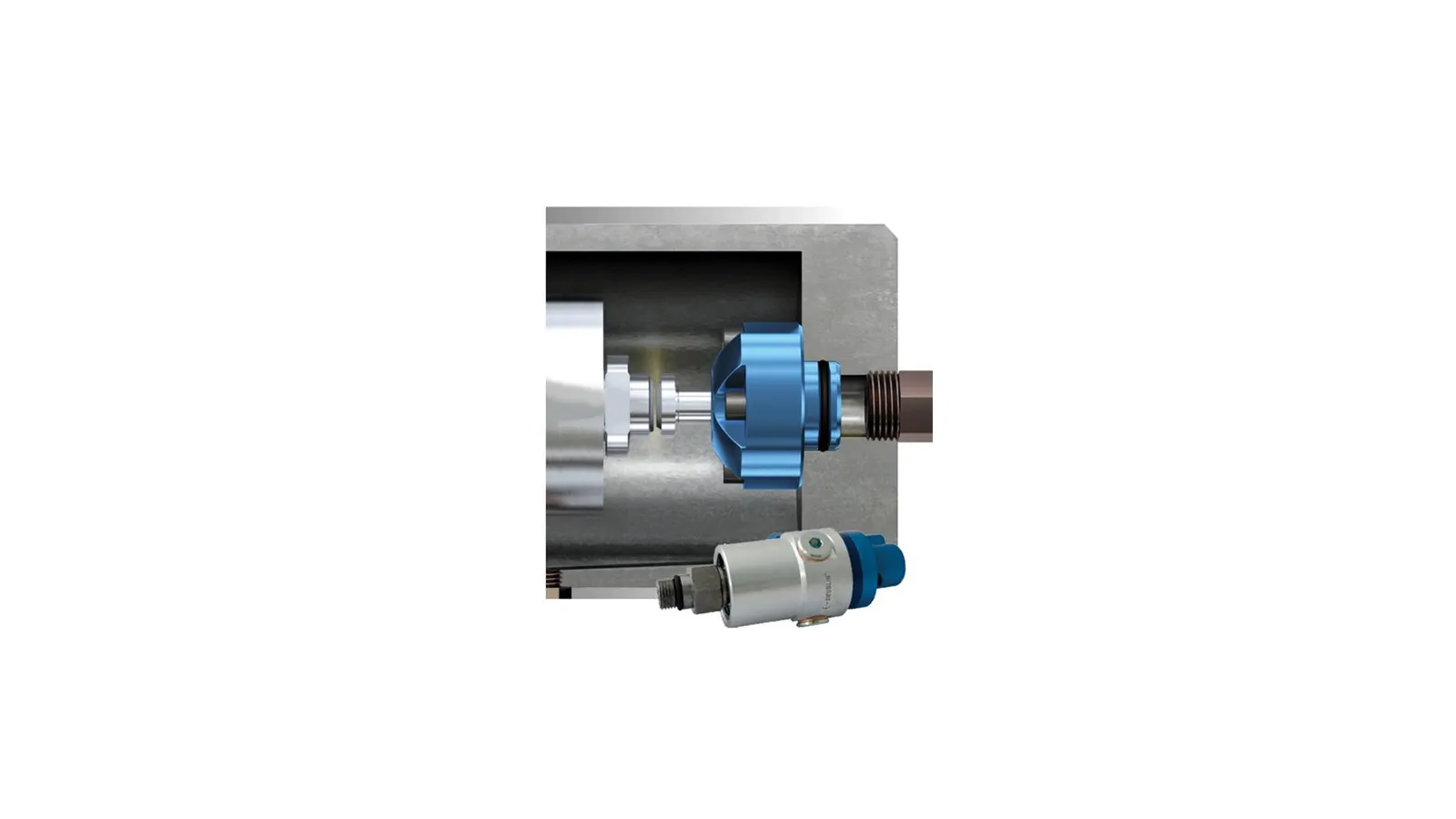
Table of Contents
The passage count is the first structural decision in a rotary union — and the one most often guessed wrong. Choose too few passages and you bolt on extra unions or reroute hoses around the machine. Choose too many and you pay for channels you never use, add seal lands you do not need, and grow the envelope until the union no longer fits behind the spindle. Both mistakes surface at commissioning, when the machine is already on the floor.
This guide compares single and multi-passage rotary unions at the level of structure, not just price: how each is built, how the seals are arranged, how pressure behaves between adjacent channels, and what the size, maintenance and cost penalties actually are. It ends with a decision path you can run through with your circuit list in hand. For the broader picture of how unions fit into a machine, start with our rotary union guide.
The Snapshot
- Single passage: one inlet, one outlet, one dynamic seal set — the workhorse for air, water, coolant and steam when the rotating side needs exactly one supply.
- Multi passage: two to eight independent channels in one body, each with its own seal path — for multiple media, supply + return pairs, or combined hydraulic, pneumatic and coolant service.
- Rule of thumb: if the rotating assembly needs more than one independent circuit, a multi-passage union is usually cheaper and simpler than a stack of single unions — once you count hoses, brackets and service points.
- Cost: a multi-passage union typically costs 2-4× a single-passage unit of similar size, but replaces several unions and their plumbing.
- Envelope: every extra channel adds an axial station of groove, seal lands and port boss — multi-passage bodies typically run 20-40% longer than a single-passage unit with the same largest port.
How Each Type Is Built
A rotary union is a rotating shaft (rotor) turning inside a stationary housing. The fluid enters the housing, crosses a dynamic seal boundary, travels along a passage in the shaft, and exits at the rotating side — or the reverse. The passage count decides how many of those boundaries exist and where they sit.
Single-passage construction
A single-passage union is one axial bore through the rotor. The housing carries one inlet port; the fluid crosses a single dynamic seal pair between the stationary housing and the rotating shaft, then runs straight down the bore to the outlet. Sectionally, from outside in: housing wall, static O-ring, dynamic seal (lip seal, face seal or carbon-graphite running face, depending on media), rotor wall, flow bore. One seal set to leak, one port pair to plumb, one rebuild kit.
Multi-passage construction
In a multi-passage union the rotor is machined with a series of annular grooves along its length, each groove isolated from its neighbours by sealing lands. Every groove is fed by its own radial drill into the rotor bore or by a separate axial bore, and the housing has one port per groove, positioned at the matching axial station. The medium for channel 2 crosses the seal land at station 2, runs into the groove, and down its own drill — physically separated from channel 1 by the land between them.
Each channel needs a dynamic seal on both sides of its groove. Adjacent channels share the land between them, so the seal count does not double per channel: a 2-passage union typically has three dynamic sealing positions, a 4-passage unit about five, a 6-passage unit about seven. That is the structural price of multi-passage: the union is a stack of sealing stations, and every station is a potential wear point, a potential leak path, and a machined feature that costs length.
Single Passage Unions
A single-passage rotary union has one flow path: one inlet on the housing, one outlet on the shaft (or vice versa). It is the simplest, most common, and least expensive rotary union, and for a large share of machines it is also the correct one.
Typical applications: air to a rotating gripper or index table, water or coolant to a chill roll, steam to a single dryer cylinder, vacuum to a rotating pickup, coolant through a spindle at moderate pressure. If the rotating part needs exactly one medium and no return line, a single-passage union is the right call — nothing is gained by adding channels you will cap off.
Advantages: lowest cost, compact, light, easy to maintain, widely stocked, and the largest effective port for the body size. Disadvantages: only one channel — no way to carry a second medium or a return flow through the same body without a second union. See the single-passage product range for the standard port sizes and thread options.
Multi Passage Unions
A multi-passage union carries 2, 4, 6 or more independent flow channels through one body. Each channel has its own inlet/outlet pair and its own seal path, so different media can travel side by side without mixing — provided the seal lands between channels hold, which is exactly the design question this guide covers below.
Typical applications: hydraulic rotary actuators (pressure + return + drain + pilot), excavator attachments with several hydraulic functions through one swivel, grippers with air + vacuum on the same wrist, spindles with coolant + air blow-off + oil mist lubrication, rotary tables with multiple services, and test stands with many circuits rotating together.
Advantages: one compact unit replaces several unions, fewer hoses, less rotating mass, cleaner machine layout, and one service point. Disadvantages: higher cost, more seal lands, smaller individual ports than an equivalent single union, and a longer body. The multi-passage product range covers the standard 2/4/6-channel configurations.
Side-by-Side Comparison
The comparison below is at the level of typical standard products. The absolute numbers move with pressure rating, port size and materials, but the relationships hold across the market.
| Property | Single passage | Multi passage (2-6+) |
|---|---|---|
| Flow paths | 1 | 2 to 8 independent |
| Effective port size for body size | Largest | Each channel smaller; ports shrink as count rises |
| Media | One medium per union | Several media in one body, sealed independently |
| Dynamic seal positions | 1 set | ~3 (2-ch), ~5 (4-ch), ~7 (6-ch), typical |
| Unit price vs single | Baseline | 2-ch ≈ 1.5-2×; 4-ch ≈ 2.5-4×; 6-ch ≈ 4-6× |
| Body length | Shortest | Typically +20-40% for same largest port |
| Maintenance | One seal kit, quickest rebuild | One service point but more seals; labelled ports essential |
| Space on machine | One union + its hose loop | One compact body vs several unions and hose runs |
Read the table as a trade: the multi-passage union concentrates complexity in one precision component so the machine around it stays simple. The single-passage union keeps the component simple and pushes the complexity into hose routing.
Coaxial vs Parallel Arrangements
"Multi passage" describes the channel count, not the physical layout. Two arrangements dominate, and they behave differently in the machine.
Coaxial (concentric) arrangement
All channels share the rotation axis. The rotor carries one central bore plus annular grooves stacked along its length; each groove feeds its own channel via radial drills, and the housing ports sit at successive axial stations. This is the standard for spindles and hydraulic swivels because it keeps the outer diameter small — the union passes through the rear bearing housing, and the ports are distributed along the body instead of around it.
Parallel arrangement
The channels run as separate axial bores through the rotor and housing, side by side, each fed from its own port. Fewer grooves to machine, and each bore can be individually sized — useful when one channel needs a large coolant flow next to small pilot lines. The cost is a larger outer diameter for the same port count, and the ports cluster on one face or side, which complicates hose routing in tight machine frames.
| Criterion | Coaxial (concentric) | Parallel (side-by-side bores) |
|---|---|---|
| Channel geometry | Central bore + annular grooves at successive axial stations | Separate parallel bores through rotor and housing |
| Body shape | Long, slim | Short, fat |
| Port layout | Distributed along the length | Clustered on one face or side |
| Best fit | Spindles, hydraulic swivels, through-bore machines | Panels, index tables, rigs with one dominant large channel |
| Seal arrangement | Sealing lands stacked axially, shared between grooves | Each bore sealed independently |
| Typical trade-off | Length grows with channel count | Diameter grows with channel count |
There is a third, field-level "parallel" option: several single-passage unions bolted side by side, each serving one circuit. It is the easiest to buy, stock and service, and the worst on space, hose routing and rotating mass. It is the right answer when the machine has room, the speeds are low, and spare-part simplicity beats integration.
Pressure & Leakage Crosstalk
Crosstalk is what happens when the pressure in one channel acts on the seals of another. It is the failure mode that most often catches buyers of multi-passage unions off guard, because it is invisible in a catalogue drawing.
In a coaxial multi-passage union, the sealing land between two adjacent grooves sees the pressure differential between those two channels — not the system pressure, not the supply pressure, the difference. Put a 400 bar hydraulic channel next to a 6 bar air channel, and the land between them is asked to hold roughly 394 bar. If it leaks, high-pressure oil migrates into the air channel: the pneumatic circuit contaminates, the actuator on that circuit behaves erratically, and the machine faults in a way that looks nothing like a seal failure.
Working pressure in hydraulic rotary service is typically 100-500 bar (common ratings: 250-350 bar standard hydraulic, specials to 500 bar). Pneumatic channels typically run 6-16 bar, coolant 10-70 bar. The wider the gap between adjacent channels, the more the design has to work to protect the low-pressure side. Three mechanisms matter:
- Channel ordering: arrange channels by pressure along the body — highest at one end, descending to the other — so no single land holds the full system spread.
- Drain / vent grooves: an intermediate groove between a high-pressure and a low-pressure channel, vented to atmosphere or to tank. Internal leakage lands in the drain and is seen at the tell-tale port before it reaches the next channel.
- Derating: a pneumatic channel adjacent to high-pressure hydraulic may be rated below its standalone pressure, or isolated by a drain, because the land has to hold the differential, not just the channel pressure.
When you spec a mixed-media union, state the pressure of every channel and the order they sit in the machine. A supplier can only protect against differentials they have been told about.
Seal Design: Count, Type, and Risk
The seal system is where single and multi-passage unions differ most, and it drives both the leak behaviour and the rebuild cost.
Seal types per passage
- Elastomer lip seals: the standard for air, water and oil at moderate pressure and speed. Two lips facing opposite directions are common on hydraulic channels — the second lip catches whatever the first passes, and the space between is often vented or drained.
- Mechanical face seals: lapped metal or ceramic faces running against a stationary counterface. Used for high pressure, high speed, or both, where lip seals would wear out or extrude.
- Carbon-graphite faces: the classic steam and high-temperature joint — a carbon ring running on a hardened steel or ceramic seat. Rarely used in multi-passage hydraulic bodies, common in single-passage steam service.
In a multi-passage union, every channel gets its own dynamic seal set matched to its own media and pressure. That is the strength and the weakness: the right seal for each medium, but more seals in total.
Seal count and leak risk
More seal lands means more potential leak paths, and the arithmetic matters at rebuild time — the kit for a 6-passage union contains several times as many dynamic seals as a single-passage kit. But total leak rate is usually dominated by the highest-pressure channel, not by the number of seals. What the extra lands really change is the failure signature:
- A leak on a single-passage union goes to atmosphere, visibly, at the union.
- A leak on an inner land of a multi-passage union can go into the neighbouring channel instead of outside — silent cross-contamination. This is exactly why drain grooves and tell-tale ports exist, and why a small weep from a drain port is a service signal, not just cosmetic.
Two practical rules: keep the seal material of each channel matched to its media (an FKM seal chosen for oil is not automatically right for hot water), and never interchange seals between channel positions during a rebuild — the kits are position-specific.
How to Choose
Start by counting the independent circuits the rotating assembly needs — media and returns both count. Then walk the decision tree:
- 1 circuit (one medium, no return) → single-passage union. Stop here.
- 2 circuits, same medium, supply + return (hydraulic P+T, steam + condensate) → 2-passage.
- 2 circuits, different media (air + vacuum, coolant + air) → 2-passage mixed.
- 3-4 circuits (two hydraulic circuits, or hydraulic + air + coolant) → 4-passage.
- 5-6 circuits (three hydraulic circuits, or complex mixed service) → 6-passage.
- 7+ circuits → 8-passage or a custom body — talk to an engineer before committing, because the envelope and seal stack get hard to fit into standard frames.
Then check four constraints before you finalize:
- Pressure spread: what is the largest differential between adjacent channels? If a high-pressure hydraulic channel sits next to a low-pressure air channel, confirm the design uses channel ordering or a drain groove (see the crosstalk section above).
- Flow per channel: small channels limit flow. A 4-passage union carrying four G1/8-class ports will not feed a circuit that needs G1/2.
- Envelope: measure the space behind the rotating part. Multi-passage bodies run longer — the size section below gives the numbers.
- Speed: longer bodies increase overhung load on the bearings and raise seal face velocity. Above a few thousand RPM, confirm the specific model's speed rating with the PV curve, not the catalogue headline.
When in doubt, send the full circuit list to a supplier — media, pressure, flow and port preference for every channel — and let them map it to a standard passage count. Guessing the count and then discovering a missing channel at commissioning is the expensive path.
Passage Counts at a Glance
The table maps typical channel counts to the applications they serve. Pressures are typical standard ratings, not maximums — always confirm against the specific model.
| Passages | Typical media | Typical application | Typical working pressure |
|---|---|---|---|
| 1 | Air, water, coolant, steam, vacuum | Grippers, chill rolls, dryer cylinders, spindle coolant flush, vacuum pickups | Air 6-16 bar; water 10-20 bar; through-spindle coolant up to ~70 bar; steam up to ~17 bar |
| 2 | Same media supply + return (hydraulic P+T, steam + condensate); or air + vacuum / coolant + air | Hydraulic cylinders through a swivel, steam dryers, vacuum grippers, spindle blow-off | Hydraulic 100-350 bar; steam ~10-17 bar; air 6-16 bar |
| 4 | Two hydraulic circuits, or hydraulic + pneumatic + coolant | Rotary actuators, index tables, excavator booms, spindle coolant + air + clamp | Hydraulic 100-500 bar; mixed-media channels per circuit |
| 6 | Three hydraulic circuits, or complex mixed service | Excavator attachments, test stands, coilers, rotary index machines | Hydraulic typically up to 350 bar (specials 500 bar) |
| 8 | Multi-media, high channel count | Custom tooling, rotary index machines, OEM specials | Mixed; hydraulic channels typically ≤ 350 bar |
Note what the table does not say: it lists typical applications, not maximum capability. A 2-passage union can carry two different media, a 4-passage union can carry four. The table is a map of what machines actually use, which is the safer guide for a first spec.
Common Channel Combinations
- 2-passage, same media: supply + return (hydraulic cylinder through a swivel, steam + condensate siphon).
- 2-passage, different media: air + vacuum for grippers, coolant + air for spindle blow-off.
- 4-passage hydraulic: two hydraulic circuits (pressure + return each) for rotary actuators.
- 6-passage: three hydraulic circuits or complex combinations for excavators and test stands.
- Mixed: 2 hydraulic + 2 pneumatic in one body for combined actuation and tooling.
Worked example: the CNC motorized spindle
The classic multi-passage machine is the motorized spindle, where oil, air and water share one rotating interface. A typical rear-of-spindle union carries four channels:
- Coolant to the tool — through-spindle coolant at 40-70 bar typical, sometimes higher for deep drilling. Usually the central passage, because it must run through the drawbar.
- Air blow-off / air curtain — 6-8 bar, to clear chips from the tool taper and dry the spindle nose between cycles.
- Oil-air or oil mist to the front bearings — a few bar, pulsed with the lubrication cycle.
- Hydraulic tool clamping — 50-100 bar typical for the drawbar actuator on HSK tooling.
Four media at four different pressure levels in one rotating body. This is why the coaxial arrangement exists: there is no room at the rear of a spindle for a stack of single unions, and each extra union would add a hose loop, a bracket and a second, third, fourth leak point. The channel ordering matters here too — the high-pressure clamp channel and the low-pressure air channel must be separated in the stack, or given a drain between them, so a clamp-side seal leak does not pressurize the air curtain line.
Size, Weight, and Envelope Trade-Offs
Every channel adds an axial station to a coaxial union: groove, two sealing lands, port boss. The body grows in length roughly linearly with the channel count, and the practical consequence is a union that is typically 20-40% longer than a single-passage unit of the same largest port — and heavier, because the rotor and housing blanks are bigger.
The length penalty is not just a fitting problem. Three effects compound:
- Overhung load: a longer body cantilevers further from the machine bearing. On a spindle or any high-speed application, that shifts the vibration and load balance of the assembly.
- Interference: behind a spindle, the added length can collide with the rear bearing housing, the drawbar actuator or the machine frame. Measure the cavity before you commit to a passage count.
- Seal face velocity: more stations mean more seal faces at the same RPM, and seal wear scales with pressure × velocity. A long 6-passage body at high speed runs more total seal face work than a 2-passage unit, all else equal.
Parallel-bore layouts flip the trade: they stay shorter but grow in diameter, which creates its own interference problem in bores and housings. If the machine cavity is tight in both directions, the passage count and the arrangement have to be resolved together, not one after the other.
Cost & Complexity
Multi-passage unions are precision parts: each channel needs its own seal path, and the body is machined from a larger blank. On unit price, expect roughly:
- 2-passage ≈ 1.5-2× a comparable single-passage unit
- 4-passage ≈ 2.5-4×
- 6-passage ≈ 4-6×
So the multi-passage premium over a single-passage unit is typically 2-4× for the 2-4 channel range where most machines live. The absolute numbers move with pressure rating, materials and port size — a 500 bar hydraulic multi-passage unit costs more than a 15 bar pneumatic one regardless of channel count.
The economic comparison that matters is against the alternative: two or three single unions plus their hoses, brackets, fittings and service points. For a machine that needs three circuits on one rotating assembly, the choice is usually between one 4-passage union and three single unions with a bundle of hoses between them. The multi-passage unit wins on total installed cost, machine cleanliness and reliability — fewer hose connections is fewer leak points — while the three singles win on shelf simplicity and per-part serviceability.
Also budget the rebuild, not just the purchase: seal kits scale with channel count. A 6-passage kit costs more than a 2-passage kit, but it is one kit, one service event, and one scheduled stop — which is the point of concentrating the complexity.
Installation & Maintenance Differences
The differences show up in three places: installation, service access, and rebuild discipline.
Installation
- Single-passage: two connections, thread or flange mount, alignment is forgiving. Most units are fitted in minutes.
- Multi-passage: four, six or eight connections, and the ports must be labelled and matched to the circuit list. Swapping two channels on a hydraulic union reverses an actuator or sends air into the oil tank — the failure is not immediate, which makes it worse. Heavier bodies may need a support bracket so the union's weight does not cantilever off the machine bearing.
Service access
Multi-passage unions concentrate the service point — one union to reach instead of three — but the union itself is longer, and the ports around it are denser. Check that every port is reachable with a wrench before the machine is built, not after. A union you can reach gets maintained; one buried under a hose bundle gets ignored until it fails.
Rebuild discipline
Single-passage rebuilds are one seal set, one orientation, hard to get wrong. Multi-passage rebuilds are position-specific: the kit contains several seal types, and each belongs to a specific channel station. Follow the disassembly order in the manual (end cap → shaft → seal stack), replace all dynamic seals at once rather than only the leaking one, and confirm the drain/vent ports are clear before reassembly. A weep from a tell-tale port after rebuild usually means a seal was seated in the wrong station or the drain is blocked.
Quick Answers
What does "passage" mean in a rotary union?
A passage is one independent flow channel through the union. Single-passage has one; multi-passage has two or more, each with its own inlet/outlet and its own seal path.
Can a multi-passage union carry different media?
Yes — each channel is sealed independently, so air, water, oil and vacuum can travel through the same body without mixing. The caveat is pressure: channels with a large pressure differential need the ordering and drain protection described in the crosstalk section above.
Is a multi-passage union always better?
No. For one medium with no return, a single-passage union is cheaper, simpler, shorter, and has bigger ports. Multi-passage earns its cost when the rotating assembly needs several circuits and the machine cannot afford a stack of unions.
How many passages do I need?
Count the independent circuits (media + returns) the rotating part needs. That number — or the next standard size up — is your passage count. Then check the pressure spread, flow per channel and envelope against the tables above.
Why are multi-passage unions longer?
Each channel needs its own axial station — groove, sealing lands and port boss — so the body grows roughly linearly with channel count. Multi-passage bodies are typically 20-40% longer than a single-passage unit with the same largest port.
Do I need a drain or vent between high- and low-pressure channels?
If the pressure differential between adjacent channels is large — a 350-400 bar hydraulic channel next to a 6-10 bar air channel — yes. A drain groove vents internal leakage to a tell-tale port instead of letting it cross into the neighbouring channel.
Spec It Right the First Time
Passage count is a structural decision — changing it later means a new union, new ports and new hoses. If you have a circuit list, send it over: media, pressure, flow and port preference for every channel. Our engineers map it to a standard passage count, confirm the pressure differentials between channels are protected, and quote the multi-passage and single-passage options side by side so you can compare total installed cost, not just unit price.
Request a quote or send your circuit list through the contact page — we respond within one business day with pricing, lead time and a spec sheet you can build against.
NEXT STEP
Ready to Spec the Right Rotary Union?
Send us your requirements — our team responds within 24 hours with pricing and lead time.
Written by
LOOP ENGINEERING TeamRotary union engineering specialist. LOOP ENGINEERING helps machine builders and maintenance teams source factory-direct rotary unions.