
Rotary Union Selection Guide: How to Choose
Table of Contents
Choosing the wrong rotary union costs more than the union itself. A mis-speced seal fails in weeks, and the downtime, freight and installation often add up to 10-20 times the part price. This guide gives you a repeatable 7-step process to spec a rotary union correctly the first time — the same process our engineers use on OEM projects.
You will learn how to define media, pressure, speed and temperature, how to pick port size and passage count, and how to choose seal materials for your duty. Work through the steps in order, and you will have a complete specification by the end.
The Snapshot
- Media first: air, water, coolant, oil, steam or vacuum decides the whole union family.
- Pressure: include spikes, not just steady state — a 10 bar union at 15 bar spikes fails fast.
- Speed: above 6,000 RPM, use a purpose-built high-speed union, not a standard one.
- Temperature: above 100 °C, standard NBR seals are out; choose FKM, PTFE or carbon faces.
- Ports: G (BSPP), NPT, UNF and metric threads are not interchangeable — match your machine.
- Passages: multi-channel unions replace several single unions in one compact body.
- Mounting: thread mount for light duty, flange mount for torque and larger machines.
Every row in this guide maps to one line on a supplier's quotation form. If you can answer the seven steps below, you can compare quotes from any manufacturer on the same basis — which is the only way to find out who is under-specing the seal and who is over-pricing the spare kit.
Step 1: Identify the Media
The medium is the single biggest driver of the rotary union design. It determines the seal family, housing materials and pressure rating:
- Compressed air / vacuum: single-passage pneumatic unions with NBR or FKM seals, aluminum housings, 15 bar typical. Compact and low-cost.
- Water / coolant: water unions at 10-15 bar for general service; through-spindle coolant unions at up to 70 bar for machine tools.
- Hydraulic oil: multi-channel high-pressure unions at 250-500 bar with hardened steel rotors and dedicated seal stacks.
- Steam: carbon-graphite seal faces, hardened steel rotors, siphon passages for condensate return, rated to ~180 °C.
- Hot oil / thermal fluid: similar to steam in temperature range but with oil-compatible seals.
If you transfer more than one medium (air + water, oil + pilot air), count that as a multi-passage application and move to Step 6.
Media Selection Matrix
The matrix below covers the standard duty families we quote every week. Ranges are typical for catalog models — always confirm against the specific datasheet, because a coolant union for a 20,000 RPM spindle is a different machine from a coolant union for a 1,500 RPM lathe.
| Media | Pressure (typical) | Temperature (typical) | Seal family | Housing |
|---|---|---|---|---|
| Compressed air | up to 15 bar (some to 20) | -30 to +80 °C | NBR or FKM | aluminum |
| Water / general coolant | 10-20 bar | +5 to +60 °C | NBR | brass or aluminum |
| Through-spindle coolant | 40-70 bar | +5 to +60 °C | FKM + hard faces | steel / stainless |
| Hydraulic oil | 250-500 bar | -20 to +80 °C | dedicated hydraulic stacks | hardened steel |
| Saturated steam | 10-17 bar | up to 180 °C (specials higher) | carbon-graphite faces | carbon steel / stainless |
| Vacuum | down to -0.9 bar g | ambient | NBR or FKM | aluminum |
| Thermal oil | up to 10 bar (system dependent) | up to 320 °C | PTFE / carbon + HT elastomers | stainless |
Compatibility Rules That Cost Less Than a Rework
- Abrasive media shortens face life: suspended grit in coolant or process water acts as lapping paste on the seal faces. Filter to 25-50 micron before the union and face life can triple; run it unfiltered and expect replacement in months, not years.
- Oil and NBR are fine; oil and EPDM are not. EPDM swells in mineral oil. NBR swells in hot water above roughly 90 °C. Match the elastomer to the media, not to the price list.
- Vacuum changes the seal logic: the face is held in contact by springs and pressure differential; at vacuum the differential reverses, so a vacuum-rated union needs the same face contact in both directions. A standard pressure-rated union can suck air at the face.
- Mixed media means sealed channels: air plus oil in one body is normal, but the channels must be independently sealed so a pilot-pressure leak cannot contaminate the oil circuit.
Step 2: Define Pressure
Record the maximum working pressure at the union — not the pump pressure, not the line average. Include pressure spikes from valve closing, thermal expansion, or cold starts. A good rule: spec at 1.5× your normal operating pressure.
Typical ratings by family: pneumatic 15 bar (some to 20 bar), water 10-20 bar, through-spindle coolant 40-70 bar, hydraulic 250-350 bar (specials to 500 bar), steam 10-17 bar saturated.
If you are unsure about spikes, tell your supplier the pump flow, line size and cycle pattern — an engineer can estimate the transient pressure rather than you guessing.
Rating Classes by Family
| Family | Working pressure (typical) | Proof / test pressure | Notes |
|---|---|---|---|
| Pneumatic | 15 bar (specials to 20) | 1.5× rated | aluminum bodies; derate at high temperature |
| Water / coolant | 10-20 bar | 1.5× rated | through-spindle versions to 70 bar |
| Hydraulic | 250-350 bar; to 500 bar | 1.5× rated, tested before shipment | steel rotors, dedicated seal stacks |
| Steam | 10-17 bar saturated | 1.5× rated | rating tied to saturation temperature, see table below |
Proof pressure is not a service margin — it is a one-time factory test (we hydrostatically test every hydraulic union at 1.5× rated pressure before shipment). Burst margins on well-built unions are typically 4× working pressure or higher, but you should never plan to operate near proof pressure.
Saturated Steam: Pressure and Temperature Are the Same Number
For saturated steam you cannot pick pressure and temperature independently — the saturation curve fixes one from the other. Rounding to the nearest 0.1 bar, the standard engineering values are:
| Saturation temperature | Absolute pressure | Gauge pressure |
|---|---|---|
| 100 °C (212 °F) | 1.01 bar | 0 bar g |
| 120 °C (248 °F) | 2.0 bar | 1.0 bar g |
| 140 °C (284 °F) | 3.6 bar | 2.6 bar g |
| 160 °C (320 °F) | 6.2 bar | 5.2 bar g |
| 180 °C (356 °F) | 10.0 bar | 9.0 bar g |
| 200 °C (392 °F) | 15.5 bar | 14.5 bar g |
Use this table two ways. First, check that the union rating covers your operating point — a standard steam union rated to 180 °C / 10 bar covers everything up to 9 bar g; past that you need a higher-rated model. Second, if a dryer is running "180 °C steam" at 12 bar gauge, something is wrong with the readings — that combination does not exist on the saturation curve and the machine is either superheated or the gauge is faulty.
Pressure spikes on steam lines come from fast-closing control valves and from condensate slugs slamming into the union. Keep the steam trap and condensate line sized correctly — a flooded line delivers water hammer at several times the working pressure.
Step 3: Determine Speed
Speed is measured in RPM at the rotating shaft. The critical question is whether you run continuous or intermittent duty at that speed, because heat generation scales with both.
- Under 500 RPM: any standard union works; focus on alignment and lubrication instead.
- 500-3,000 RPM: standard unions with precision ball bearings cover most automation and general machinery.
- 3,000-6,000 RPM: check the specific model's speed rating; smaller bodies and lower inertia help.
- Above 6,000 RPM: use a purpose-built high-speed union (10,000-20,000+ RPM) — standard seals overheat and wear out in days.
Note that speed and pressure interact: the PV value (pressure × velocity at the seal face) is the real limit. A union rated 20,000 RPM at 10 bar air may be rated only 8,000 RPM at 70 bar coolant. Ask for the PV curve if your duty is at the edge.
Speed Bands and What They Demand
| Speed band | Union type | What to specify |
|---|---|---|
| under 500 RPM | any standard | alignment and hose support; speed is not the constraint |
| 500-3,000 RPM | standard, precision ball bearings | check radial load on the bearings from hose weight or belt pull |
| 3,000-6,000 RPM | standard but verify model rating | smaller body diameter, lower inertia; confirm with the PV curve |
| above 6,000 RPM | high-speed series, 10,000-20,000+ RPM | hybrid ceramic bearings, balanced rotor, micron-level concentricity |
The face velocity that drives PV is roughly π × seal diameter × RPM / 60. That is why a small-diameter high-speed union can run faster than a large one at the same PV limit — spindle unions are built long and thin for exactly this reason. Our high-speed range uses hybrid ceramic ball bearings, sealed for life, with balanced rotor assemblies held to micron-level concentricity for 10,000-20,000 RPM spindle duty.
Continuous duty deserves margin: as a practical rule, if the spindle runs at speed for more than an hour at a stretch, keep the union at or below 80% of its maximum speed rating. Intermittent cycles (indexing tables, short bursts) can run closer to the limit because the seal gets time to shed heat.
Step 4: Temperature Limits
Record both media temperature and ambient temperature. The seal material is chosen on the maximum continuous temperature:
- NBR (nitrile): -30 to +100 °C. The standard, low-cost choice for air, water and oil.
- FKM (Viton): -20 to +200 °C. For higher temperature and aggressive chemicals.
- PTFE: up to +260 °C in some compounds. For steam, solvents and low-friction applications.
- Carbon graphite faces: for steam and high-temperature rotary joints — the face material, not an elastomer, does the sealing.
Also consider the housing material at temperature: aluminum is light but limited to roughly 150-180 °C continuous; stainless or steel housings extend that. For steam, standard designs use steel or stainless bodies.
Elastomer Operating Ranges
| Material | Continuous range (typical) | Strong points | Watch out for |
|---|---|---|---|
| NBR (nitrile) | -30 to +100 °C | low cost; air, water, mineral oil | hardens above 100 °C; poor ozone resistance |
| HNBR (hydrogenated nitrile) | -25 to +150 °C | oil compatibility at higher temperature | cost; still not for live steam |
| FKM (Viton) | -20 to +200 °C | high temperature, aggressive chemicals | not for some amines and hot steam above 200 °C |
| EPDM | -40 to +150 °C | hot water, low-pressure steam, weathering | swells in mineral oil and fuels |
| PTFE-based | -200 to +260 °C | chemical resistance, low friction | cold flow under load; poor abrasion resistance |
| FFKM (perfluoroelastomer) | -10 to +315 °C | extreme temperature and chemical duty | cost — often 10× FKM; justify it |
Two temperature traps that cause most field failures. First, ambient heat: a union on a dryer hood or beside a furnace sees radiated heat on top of the media temperature — quote the housing temperature, not just the media temperature. Second, thermal shock: admitting 180 °C steam into a cold union, or flooding a hot steam union with cold water, cracks faces and relaxes O-rings. Warm the line before opening the valve, and drain condensate before start-up.
Above roughly 150-180 °C no elastomer can do the sealing job reliably, which is why steam unions switch to carbon-graphite faces that seal by mechanical contact, with elastomers confined to static joints that stay cooler.
Step 5: Ports & Threads
Port size and thread type must match your hose, fitting or machine interface. The four common thread standards:
- G (BSPP / parallel): the most common worldwide, sealed by O-ring or washer. Sizes from G1/8 to G2.
- NPT (US taper): common in North America, sealed by thread taper and sealant.
- UNF / UNC (US parallel): used on many OEM machine interfaces, often with O-ring face seal.
- Metric: common in European and Asian machinery, especially DIN-style.
A common mistake is ordering a G union for an NPT machine — they look similar but leak. When in doubt, measure the thread pitch with a gauge or send a photo of the fitting to your supplier.
Thread Standards Side by Side
| Standard | Thread angle | Form | Seal method | Common sizes |
|---|---|---|---|---|
| G (BSPP) | 55° | parallel | bonded washer or O-ring | G1/8 to G2 |
| R / Rp (BSPT) | 55° | tapered | thread sealant or PTFE tape | R1/8 to R2 |
| NPT | 60° | tapered | thread sealant / tape on taper | 1/8" to 2" |
| NPSM | 60° | parallel | gasket or O-ring | 1/8" to 2" |
| UNF / UN (SAE) | 60° | parallel | O-ring boss or 37° flare | 1/4-28 to 1-1/2-12 |
| Metric (ISO 6149 / DIN) | 60° | parallel | O-ring face seal | M12×1.5 to M42×2 |
The thread angle difference matters: G and BSPT use a 55° profile, NPT and UN use 60°. Screwing a G fitting into an NPT port engages the threads on the flank mismatch and leaks no matter how much tape you apply. Two rules: state the standard and the size together (a "G1/2" is unambiguous, a "half inch" is not), and never mix taper with parallel unless the supplier explicitly designed the adapter for it.
Every adapter you add between union and hose is a potential leak point and a moment arm for vibration. If the machine interface is unusual, it is cheaper to order the union with the right port than to stack adapters — custom port configurations are a standard part of OEM supply.
Step 6: Passage Count
Passages are the number of independent flow channels through the union:
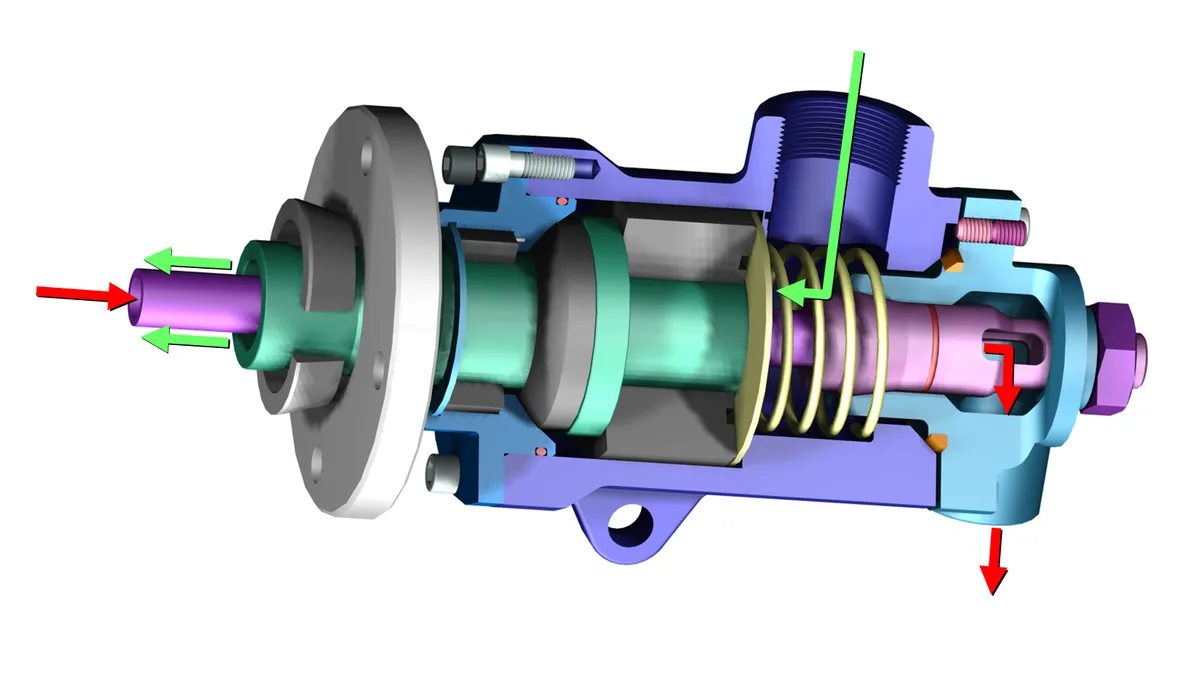
- Single passage: one inlet, one outlet. The vast majority of air, water and steam applications.
- 2-passage: two channels — e.g. supply + return (steam + condensate), or two independent media.
- 4-passage / 6-passage: multiple hydraulic channels for rotary actuators, grippers, or combined fluid + pneumatic service.
Multi-passage unions are more expensive per channel than single unions, but they save space, weight and hose routing on complex rotating assemblies. If your machine has several rotating supplies, a multi-passage union often beats a stack of single unions.
Single vs Multi-Passage
| Configuration | Channels | Typical media mix | Cost per channel | Typical use |
|---|---|---|---|---|
| Single passage | 1 | air, water or steam alone | lowest | majority of applications |
| 2-passage | 2 | steam + condensate, supply + return | low | heated rolls, dryers, chiller circuits |
| 4-6 passage | 4-6 | air + hydraulic + water in any combination | medium | rotary tables, indexing heads, tool changers |
| 8+ / hybrid | 8+, or fluid + slip ring | mixed media plus power and signal | highest | test rigs, rotary platens with instrumentation |
The channel count decision is a straight space-versus-cost trade. Four separate single unions on a rotary table eat four mounting positions and four hose sets; one 4-passage union does the same job in a single body with sealed channels that cannot cross-contaminate. Our multi-passage range covers 2, 4, 6 and 8 channels, and hybrid versions combine fluid channels with electrical slip rings so power and signal reach the rotating platen in the same package.
Keep one channel free if your machine may grow: adding a sensor channel or a spare pilot line later means buying a new union, not drilling an old one.
Step 7: Mounting Style
The mounting decides how the union attaches to the machine:
- Thread mount: the shaft screws into the rotating part. Compact and simple; used on light and medium duty.
- Flange mount: the union bolts to a flange face. Handles higher torque and larger machines, easier to align.
- Shaft mount: the union supports part of the rotating shaft load — used on some steam and heavy-duty designs.
Consider access for service: a union you can reach without dismantling the machine will get maintained; one buried inside will be ignored until it fails.
Mounting Styles Compared
| Style | Attachment | Torque / load capacity | Best for |
|---|---|---|---|
| Thread mount | shaft threads into the rotating part | light to medium | compact installations, pneumatic and coolant duty |
| Flange mount | bolted to a flange face | higher torque, resists vibration | larger machines, easier alignment and removal |
| Shaft mount | union carries part of the shaft load | highest radial capacity | steam dryers and heavy rotating drums |
Orientation changes the loading too. A horizontal union on a vertical shaft carries no hose weight; the same union on a horizontal shaft carries the full hose weight as a bending load on the bearings. Support the hose within 300 mm of the union with a bracket, keep shaft runout and misalignment under 0.1 mm where the drawing allows, and the bearing and face life will track the datasheet instead of falling short.
Sizing: How Big?
Port size is not the same as required flow. Sizing works backwards from flow demand:
- Air: at 6-8 bar, a G1/8 port flows roughly 100-200 L/min; G1/4 about 300-500 L/min; G3/8 about 700-1,200 L/min. Match port to the consumption of your cylinder or nozzle.
- Water/coolant: a G1/4 at 4 bar flows about 15-25 L/min; G3/8 about 30-50 L/min. Coolant demand is driven by spindle heat load.
- Steam: condensate capacity matters more than steam flow — the siphon and condensate line must handle the condensate rate or the dryer floods.
- Hydraulic: flow sets the port and bore; pressure sets the wall thickness and seal design.
When in doubt, size up one port. The pressure drop and heat are lower on a bigger port, and the cost difference is small compared to a re-engineered machine interface.
Flow Capacity by Port Size
| Port | Air at 6-8 bar (typical) | Water at 4 bar (typical) |
|---|---|---|
| G1/8 | 100-200 L/min | 8-15 L/min |
| G1/4 | 300-500 L/min | 15-25 L/min |
| G3/8 | 700-1,200 L/min | 30-50 L/min |
| G1/2 | 1,500-2,500 L/min | 60-100 L/min |
| G3/4 | 2,500-4,000 L/min | 120-200 L/min |
These are practical service figures, not theoretical maxima — keep line velocity below about 3 m/s for water and 15 m/s for air if you want sane pressure drop and quiet operation. Above those velocities, the pressure drop across the union and its hoses grows with the square of the flow, and the extra heat goes into the seal.
For steam, size the condensate side, not the steam side: the condensate rate for a heated roll is roughly the steam consumption less the flash fraction, and an undersized siphon or return line floods the roll. Give the supplier the roll diameter, working temperature and rotation speed, and let them match the siphon assembly to it.
Seal Materials Explained
Rotary unions have two sealing systems: the static O-rings (between housing parts) and the dynamic seal faces (between rotating and stationary parts).
Elastomer O-rings (NBR, FKM, PTFE-coated) seal the static joints and are chosen by temperature and chemical compatibility. Dynamic faces are typically carbon graphite against hardened steel or silicon carbide — the carbon wears preferentially, protecting the shaft, and is replaceable as part of a seal kit.
For steam and hot service, the carbon face is often run against a ceramic or silicon carbide counterface for longer life. For abrasive media, specify a hard counterface and expect shorter seal life. Ask your supplier for the seal kit part number at purchase — it will save you days later.
Dynamic Face Materials Compared
| Face material | Temp range (typical) | Wear behaviour | Best for |
|---|---|---|---|
| Resin-impregnated carbon graphite | up to ~260 °C | wears preferentially, self-lubricating | steam, water, air — the default dynamic face; runs against hardened steel or silicon carbide |
| Silicon carbide | up to ~300 °C | very hard, long life | abrasive or high-speed service; pairs with carbon |
| Tungsten carbide | up to ~300 °C | extreme wear resistance | high-pressure hydraulic and slurry-like media |
| Bronze | up to ~150 °C | soft, conforms to the shaft | low-speed, high-pressure service; older machine designs |
| PTFE-based compounds | up to ~260 °C | low friction, chemically inert | chemical media, low-torque applications, non-abrasive duty |
Carbon graphite earns its place in most unions because it is self-lubricating and wears instead of the shaft — a worn carbon face is a 15-minute seal kit job; a worn shaft is a new rotor. The counterface choice then sets the life: hardened tool steel (58-62 HRC typical) is the workhorse, silicon carbide extends life on abrasive and high-speed duty.
Balanced vs Unbalanced Seals
An unbalanced seal lets the full line pressure push the faces together — fine at low pressure, but at high pressure the face load rises with pressure, generating heat and wear. A balanced seal uses a stepped geometry so part of the pressure force is cancelled, keeping the face load roughly constant. The practical break point is around 10-15 bar: below it, unbalanced seals are cheaper and perfectly adequate; above it, balanced seals run cooler and last markedly longer. If your duty is 40-70 bar coolant or 250-500 bar hydraulic, balanced faces are not optional — they are the difference between a seal that lasts a season and one that lasts a shift.
Budget & Lead Time
Rotary union prices span a wide range by family: pneumatic single-passage unions are typically $30-150; water and coolant unions $60-300; steam unions $150-600; hydraulic multi-passage unions $300-2,000+. Standard models ship in 1-3 weeks; custom OEM designs take 4-8 weeks including prototyping.
Budget for spares: a seal kit is usually 10-20% of the union price and turns a multi-day failure into a 15-minute repair. On critical machines, keep a spare union on the shelf for the first year, then a seal kit once you know the service interval.
Price Bands and Lead Times
| Family | Typical price | Standard lead time |
|---|---|---|
| Pneumatic single-passage | $30-150 | 1-3 weeks |
| Water / coolant | $60-300 | 1-3 weeks |
| Steam | $150-600 | 1-3 weeks |
| Hydraulic multi-passage | $300-2,000+ | 1-3 weeks |
| Custom OEM | quoted per drawing | 4-8 weeks incl. prototyping |
Total cost of ownership beats purchase price. If a failed union stops a production line for four hours, and the line earns more per hour than the union costs, the spares decision makes itself: one spare union on the shelf for the first year, a seal kit after you know the interval, and a service schedule that catches the weep before the failure. A union that costs $400 and is rebuilt twice a year with $60 kits is cheaper over five years than a $150 union replaced every six months.
Final Checklist
- ☐ Media (air / water / coolant / oil / steam / vacuum / thermal fluid)
- ☐ Max pressure, including spikes (bar or psi)
- ☐ Max speed (RPM) and duty cycle (continuous / intermittent)
- ☐ Media and ambient temperature (°C)
- ☐ Port size and thread type (G / NPT / UNF / metric)
- ☐ Passage count (1 / 2 / 4 / 6)
- ☐ Mounting (thread / flange / shaft)
- ☐ Orientation (horizontal / vertical / rotating shaft)
- ☐ Space envelope (body diameter and length limits)
- ☐ Spare seal kit part number confirmed
Fill in the first eight items and any rotary union supplier can quote you accurately. Send us the same list — our engineers reply within 24 hours with a recommended model, datasheet and quotation.
Common Specification Errors
- Quoting pump pressure instead of union pressure: the union sees the line at the machine, which includes the pump, the pressure drop of everything between, and every transient in between.
- Ignoring spikes: a 15 bar spike on a 10 bar line is the number one cause of early face failure — spec at 1.5× normal and stop guessing.
- Mixing G and NPT: 55° vs 60° thread angle means they never seal together. Measure pitch, not eyeball it.
- Running a standard union past 6,000 RPM: standard seals overheat and fail in days, not months. Buy the high-speed series for spindle duty.
- Forgetting ambient heat: a 90 °C media with NBR seals is fine until the union sits next to a 120 °C radiant surface.
- Sizing the port to the hose instead of the flow: the port must pass the required flow at acceptable velocity — see the flow table above.
- Skipping alignment and hose support: side load on the bearings shows up as vibration and short face life six months later.
- No spare kit at commissioning: the seal kit part number costs nothing at purchase and saves days when it fails.
Failure Modes and How to Prevent Them
| Symptom | Most likely cause | Action |
|---|---|---|
| Weeping at the seal face | worn face, or face material wrong for the media | fit a seal kit; check media abrasiveness and temperature |
| Leak at a housing joint | static O-ring aged, overheated, or wrong elastomer | replace O-ring; verify elastomer against the temperature table |
| Housing runs hot | PV limit exceeded, or lubrication neglected | reduce speed or pressure; restore the lubrication schedule |
| Bearing noise or vibration | misalignment, hose side load, bearing wear | realign; support the hose; replace bearings at rebuild |
| Rapid seal wear | abrasive contamination or dry running | filter the media; confirm the union is primed before start |
| Dryer floods / no condensate return | undersized siphon or condensate line | size the siphon to roll diameter and rotation speed |
Track the weep, not the failure. A face that starts weeping at the seal kit interval is doing its job — replace it on schedule and the shaft, bearings and housing last for years. Ignore the weep and the next stage is scored faces, a damaged rotor, and a rebuild bill that dwarfs the seal kit.
Quick Answers
What is the most important factor in rotary union selection?
Media. It determines the seal family, materials and pressure rating — everything else hangs off that choice.
Can I use a pneumatic rotary union for water?
Often yes — a single-passage union with NBR seals handles both air and water up to its pressure rating. Check the seal material against the media and temperature.
How do I know if I need a high-speed rotary union?
If your shaft runs above 6,000 RPM continuous, or the union is on a CNC spindle, choose a purpose-built high-speed model rather than a standard one.
What happens if I undersize the pressure rating?
The seal faces lift or the housing leaks, typically within weeks. Pressure spikes are the usual cause — spec at 1.5× normal operating pressure.
Do rotary unions need lubrication?
Many designs have a felt oiler or grease port in the seal cavity — a few drops per month extends seal life several-fold. Follow the manufacturer schedule. High-speed unions with sealed-for-life hybrid bearings need none.
How often should I replace the seal kit?
Depends on duty: light air service can run several years; continuous high-speed or abrasive duty can need attention every 6-12 months. Replace at the first sign of weeping — a kit is typically 10-20% of the union price and a 15-minute job.
What is the difference between a balanced and an unbalanced seal?
An unbalanced seal lets line pressure push the faces together; a balanced seal cancels most of that force with geometry. Below roughly 10-15 bar unbalanced is fine; above that, balanced seals run cooler and last longer.
Do I need a siphon for my steam-heated roll?
If the roll rotates, yes — condensate must be removed continuously or the roll floods and heating collapses. The siphon size follows roll diameter and speed; give the supplier those numbers.
Ready to Spec Yours?
Fill in the checklist above and send it to us — our engineers reply within 24 hours with a recommended model, datasheet and quotation. If you want to browse first, start with our steam rotary unions, high-speed series or multi-passage range, or send your operating conditions through the contact page and get a spec review and quotation within one business day.
NEXT STEP
Ready to Spec the Right Rotary Union?
Send us your requirements — our team responds within 24 hours with pricing and lead time.
Written by
LOOP ENGINEERING TeamRotary union engineering specialist. LOOP ENGINEERING helps machine builders and maintenance teams source factory-direct rotary unions.