
Pneumatic Rotary Union Guide: Air & Vacuum Rotary Joints Explained

Table of Contents
Pneumatic rotary unions are the workhorse of factory automation — small, fast, and easy to overlook until the line stops. They feed compressed air or vacuum into rotating grippers, index tables and tooling, cycling millions of times a year. This guide covers how they work, what changes between air and vacuum service, and how to pick the right one.
You will learn the design basics, the air-vs-vacuum difference, common applications, and the selection parameters that matter for automation duty.
The Snapshot
- Pneumatic rotary unions transfer compressed air or vacuum into rotating assemblies, typically at 6-15 bar.
- Compact and light: aluminum housings and precision bearings keep rotating mass and torque low.
- Single or dual passage: one channel for air, two for air + vacuum or air + pilot.
- Seals: NBR standard, FKM for higher temperature — low-friction for high cycle rates.
- Applications: pick-and-place grippers, index tables, packaging, textile, pneumatic clutches.
What Is a Pneumatic Rotary Union?
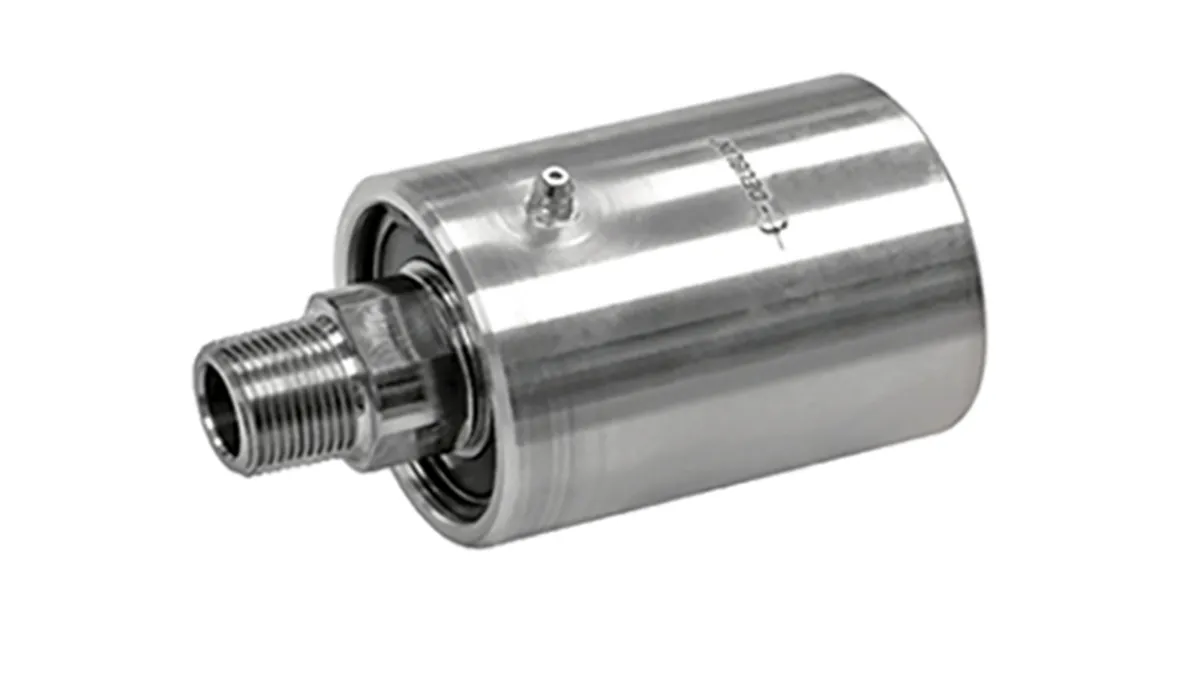
A pneumatic rotary union transfers compressed air (or vacuum) from a stationary supply into a rotating part — a gripper that spins, an index table that rotates, a roll that turns — without twisting the air hose. One inlet on the housing, one outlet on the shaft, and a seal between them that holds pressure while rotating.
It is the simplest and least expensive rotary union family. Most designs are single-passage with aluminum bodies, NBR or FKM O-rings, and precision ball bearings. Dual-passage versions add a second channel for air + vacuum or two independent air circuits.
Air vs Vacuum Service
Air and vacuum are different seal problems:
- Air (positive pressure): the seal holds pressure outward. Leakage is a visible air loss and pressure drop — usually acceptable in small amounts.
- Vacuum (negative pressure): the seal must prevent air from leaking inward. Vacuum leaks are harder to detect and directly reduce gripper holding force — so vacuum service needs tighter seals and lower leakage tolerances.
A union rated for both air and vacuum (e.g. -0.9 to 15 bar) uses seals that work in both directions. Confirm the vacuum rating if you run grippers — a union rated for air only may leak under vacuum.
Design & Seals
Core components: aluminum or stainless housing, a steel or stainless shaft, precision ball bearings, and O-ring or lip seals on the rotating interface. The shaft rotates inside the housing; the seal rides on the shaft surface, holding pressure while the parts move.
Seal materials: NBR (nitrile) is standard for dry air and general service (-30 to +100 °C). FKM (Viton) handles higher temperatures and aggressive media. For food and pharmaceutical lines, food-grade seals and stainless housings are available.
Bearings matter for life: sealed precision ball bearings keep the seal aligned and carry radial load. A union used on a cantilevered gripper takes side load — check the radial load rating.
Common Applications
- Pick-and-place grippers: air or vacuum to the rotating end-of-arm tooling.
- Rotary index tables: air to clamp or actuate stations that rotate.
- Packaging lines: air to rotating sealing and labeling heads.
- Textile machinery: air to rotating rolls and spindles.
- Pneumatic clutches and brakes: air through the rotating shaft to the actuation chamber.
- Spindle air blast: air to clear chips at the cutting tool on lighter machines.
Selection Parameters
To spec a pneumatic union, provide:
- Media: compressed air, vacuum, or both — confirm the pressure/vacuum range.
- Pressure: max working pressure (typically 6-15 bar for plant air).
- Speed: rotation speed in RPM — most pneumatic unions handle 500-3,000 RPM comfortably.
- Port size: G1/8, G1/4, G3/8 or G1/2 matching your fittings and flow.
- Passage count: single (air only) or dual (air + vacuum / two circuits).
- Mounting: thread or flange mount, and expected radial load on the shaft.
Installation & Torque
Pneumatic unions are forgiving, but a few rules extend life:
- Align the shaft axis within 0.1 mm to avoid side load on the seal.
- Use flexible hose between the fixed supply and the union inlet — rigid pipe transmits vibration and load.
- Torque to spec on the shaft thread — over-torquing distorts the seal cavity.
- Keep the air clean: a filter-regulator upstream protects the seal from contamination.
- Check cycle rate: high-frequency cycling wears seals faster; schedule seal kit replacement.
Quick Answers
Can a pneumatic rotary union handle vacuum?
Only if rated for it — check the vacuum rating (e.g. -0.9 bar). Air-only unions may leak under vacuum, reducing gripper force.
What pressure do pneumatic unions handle?
Typically 6-15 bar for plant compressed air, with some designs to 20 bar. Confirm the rating before exceeding it.
How long does a pneumatic rotary union last?
With clean air and alignment, 10,000-20,000 hours before seal service is typical. High cycle rates shorten it.
How do I choose between single and dual passage?
One circuit = single. Air + vacuum, or two independent air circuits = dual. Count the circuits the rotating part needs.
NEXT STEP
Ready to Spec the Right Rotary Union?
Send us your requirements — our team responds within 24 hours with pricing and lead time.
Written by
LOOP ENGINEERING TeamRotary union engineering specialist. LOOP ENGINEERING helps machine builders and maintenance teams source factory-direct rotary unions.