
Deublin Replacement Guide: Cross-Reference
Table of Contents
Deublin rotary unions are the industry benchmark — and often the most expensive line item in a maintenance budget. A single Deublin steam or coolant union can run $135-399, and a machine with a dozen unions wears through them every couple of years. Aftermarket replacements built to the same dimensional envelope can cut that cost by 40-70% on popular models — and up to 85% on the largest steam units — without changing the machine interface.
The real risk in this buying decision is not the replacement concept. It is the under-spec part: wrong seal grade, wrong thread, a rating that does not cover your duty. This guide covers what must match, how to cross-reference a part number, what to verify before payment, and what to ask so the replacement performs like the original.
The Snapshot
- Replacement unions are built to the same dimensional envelope, threads, and seal cavity as the original — they bolt on with no machine modification.
- Common replaced series: Deublin D-1000 (1/8"-1/2" general purpose), 1100/1200 single-passage families, D-2000 flanged steam, D-5000 high-flow steam and condensate, plus the 1102-070-079 type monoflow models.
- Cross-reference the Deublin part number on the nameplate — one number maps to one envelope, seal stack and port configuration.
- Price gap: genuine retail $135-399 versus compatible $58-188 — a 2-7 times difference depending on model and series.
- Realistic savings: 40-70% per unit on popular models, with identical service life when the seal materials and ratings match your duty.
- Typical derating: aftermarket parts are often rated 10-20% lower in maximum speed and pressure than the OEM part at the same life target. Confirm the rating at your actual duty, not the catalogue maximum.
- Key risk: counterfeit or under-spec aftermarket parts. Buy from a manufacturer that publishes materials, pressure ratings, and ISO 9001 certification.
Why Replace Instead of Rebuy?
There are four reasons plants switch to aftermarket replacements: cost, lead time, discontinued models, and support.
Cost. Genuine Deublin unions carry a brand premium. Aftermarket factories machine the same envelope at a fraction of the labor and overhead, and they do not carry the same distribution, marketing, and dealer margin structure. The price gap on the same dimensional part is typically 2-7 times — a $135-399 genuine unit against a $58-188 compatible one. The savings scale with volume: a plant standardizing on replacement unions across 20-50 machines keeps five figures a year in the maintenance budget.
Lead time. Genuine parts often ship from the regional distributor's stock or are built to order. A machine down on a failed union does not wait well. Aftermarket manufacturers commonly stock the popular series (D-1000, 1100, 1200, D-2000, D-5000) and ship in days, which is often the difference between an overnight repair and a week of downtime.
Discontinued models. This is the reason that quietly drives most conversions. Deublin, like every manufacturer, supersedes and discontinues lines. Machines built in the 1990s and 2000s run unions that are no longer in the current catalog, or are built to order with long lead times. A compatible replacement keeps that machine running without redesigning the shaft, housing, or piping. If your part number is stamped on the nameplate but no longer appears in the current catalog, a replacement manufacturer can usually machine the envelope from your sample or drawing.
Support. A factory-direct supplier can adapt the seal material for your duty — FKM for hot service, PTFE for chemicals, silicon carbide faces for abrasive media — rather than only offering the OEM's standard configuration. They will also answer sizing questions directly, without a distributor layer in between.
| Driver | Genuine Deublin | Compatible replacement |
|---|---|---|
| Unit price (typical retail) | $135-399 | $58-188 |
| Stock for popular series | Distributor stock or built to order | Factory stock, ships in days |
| Discontinued lines | Superseded, long lead or unavailable | Machined from sample or drawing |
| Seal material flexibility | Standard catalog configuration | Adapted to your media and temperature |
How Compatibility Works
Deublin unions are engineered to a set of dimensional standards: shaft thread, housing connection, seal cavity depth, face diameter, and overall length. The envelope is what makes a machine work — if the replacement matches the envelope, it installs in the same position with the same connections, and the existing piping, brackets, and shaft prep all stay untouched.
A proper replacement union must match:
- Dimensional envelope — body diameter, overall length, shaft length and thread.
- Connection threads — shaft thread (for example 5/8" UNF left hand on the 1102 type) and housing connection (for example 1/4" NPT). NPT and BSP threads are not interchangeable; a union threaded for one will not seal on the other.
- Flow passages — monoflow (single passage, media in and out through the same path) or duoflo (separate supply and return passages in one body).
- Seal cavity — depth, diameter, and face width, so the standard seal kit and service procedure apply.
- Mounting style — thread-in, flange, or clamp, matching how the machine holds the union.
- Pressure and speed rating — at least equal to the original for your duty, after any derating the supplier applies.
When the envelope matches, no machine modification is needed. That is the entire point of a "replacement" versus a "custom" union. If the supplier asks you to change the shaft, the bracket, or the piping, they are selling you a custom part, not a replacement — walk away. For the full background on how rotary unions work and how to maintain them, see our rotary union guide.
| Interface point | What must match | Failure mode if wrong |
|---|---|---|
| Shaft thread | Size, pitch, handedness | Will not thread on; leaks at the shaft |
| Housing connection | Thread type and size (NPT / BSPP / metric) | Wrong fitting, forced piping, stripped threads |
| Flange (steam series) | Bolt circle, bolt size, face diameter | Will not bolt up; gasket face mismatch |
| Overall length / body OD | Envelope limits of the machine | Interference with guards or adjacent parts |
| Ports | Count, size, flow path (monoflow / duoflo) | Wrong media routing, cross-flow |
| Seal cavity | Depth, diameter, face width | Standard seal kit will not fit |
Deublin Series & Common Models
Deublin organizes unions into series by duty. The lines most commonly replaced aftermarket, and the ones any replacement supplier should stock or tool:
- D-1000 series: 1/8"-1/2" general-purpose single-passage unions for air and water. Compact, self-supported, aluminum housing. This is the volume line in light automation and machine tool work.
- 1100 series: single-passage unions with different port configurations than the 1000 line; used in light automation and machine tool applications. The 1102-070-079 type with 5/8" UNF left-hand shaft and 1/4" NPT housing is one of the most common replacement items in the catalog.
- 1200 series: higher-capacity single-passage unions for water and coolant at moderate pressure.
- D-2000 series: flanged steam and hot-water unions with carbon seal stacks and steel bodies. Flange mounting is the defining feature — the bolt circle and face dimensions must be verified against the OEM drawing before ordering.
- D-5000 series: high-flow steam and condensate unions, often with stationary or rotating syphons, for paper, board, and dryer-roll service. These are the large-ticket items where the absolute saving is biggest.
- Other lines: duoflo double-flow unions, high-pressure coolant unions, and multi-passage designs — all replaceable aftermarket where volumes justify tooling.
| Series | Public line position | Typical service |
|---|---|---|
| D-1000 | 1/8"-1/2" general-purpose single-passage | Air, water, light coolant |
| 1100 / 1200 | Single-passage variants for machine-tool duty | Water, coolant, spindle service |
| D-2000 | Flanged steam unions | Steam, hot water, heated rolls |
| D-5000 | High-flow steam & condensate, syphon versions | Paper, board, dryer rolls |
| 1102-070-079 type | Monoflow union, 5/8" UNF LH shaft / 1/4" NPT housing | Machine spindles, small rolls |
Series naming can vary between vintages of Deublin literature, and individual models carry suffixes for port and seal configuration. Treat the series as a starting point — the specific dimensions must always be verified against the OEM drawing for your model.
How to Cross-Reference Part Numbers
The Deublin part number encodes the model and configuration. Work through these five checks in order — thread, flange, ports, media, then speed and pressure. Each one narrows the compatible part until there is only one envelope left.
- Confirm the thread. Measure the shaft thread — size, pitch, and handedness — and identify the housing connection type: NPT, BSPP (G), or metric. NPT and BSP are tapered and parallel standards respectively and are not interchangeable; a 1/4" NPT union will not seal on a 1/4" BSP fitting, and forcing it damages both threads.
- Confirm the flange. For flanged series (D-2000, D-5000): bolt circle diameter, bolt size, flange face diameter, and gasket surface. Flange dimensions are the single most common cause of returned steam unions — verify against the OEM drawing before ordering.
- Confirm the ports. Port count (one, two, or more), port sizes, and the flow path — monoflow (single passage) or duoflo (separate supply and return). A duoflo union is not a monoflow union with an extra hole; the internal construction is different.
- Confirm the media. Steam, hot water, coolant, oil, or air — and the temperature at the union. Media and temperature decide the seal face material and the elastomer, which is where most cheap failures come from.
- Confirm speed and pressure. Maximum RPM and maximum pressure at your actual duty, not the catalogue maximum. If the aftermarket rating at your duty sits below the OEM rating, you either accept the derating or move up a size.
The fastest path: read the nameplate on the union body — the part number (for example 1102-070-079) and series are stamped there. Send the part number to a replacement manufacturer together with your duty (media, pressure, speed, temperature), and ask them to confirm the envelope before you order. If the nameplate is worn, measure the shaft thread with a pitch gauge, the housing connection, the body diameter, and the overall length — a competent supplier can identify the equivalent model from dimensions alone. The full 7-step selection process for any rotary union, including sizing tables, is in our rotary union selection guide.
Dimension Check Checklist
Before payment, walk through this checklist with the supplier. Every dimension on it must be confirmed against the OEM drawing for your model — never assume a series number guarantees a dimension, because suffix letters change port and seal configurations.
| Dimension / feature | What to verify | How to confirm |
|---|---|---|
| Shaft thread | Size, pitch, handedness (NPT / BSP / UNF / metric) | Pitch gauge and thread gauge on the old part; verify against OEM drawing |
| Housing connection | Thread type and size | Gauge the fitting; confirm NPT vs BSPP explicitly |
| Flange bolt circle | PCD, bolt size, bolt count, flange OD, face finish | Measure the old flange; verify against OEM drawing |
| Overall length / body OD | Envelope limits of the machine | Check clearance against guards and adjacent parts |
| Port count and size | Number of ports, thread sizes, flow path | Monoflow vs duoflo confirmed in writing |
| Seal cavity | Depth, diameter, face width | Standard seal kit part number must be confirmed at purchase |
| Mounting style | Thread-in, flange, or clamp | Compare with the bracket on the machine |
Ask for a dimensional report with the order — a photograph of the union against a ruler is not a dimensional report. If the supplier cannot or will not confirm the envelope in writing before payment, that is the answer you needed.
Seal & Body Materials: Compatible vs OEM
The seal faces are where a rotary union lives or dies. Deublin uses carbon-graphite against hardened steel or silicon carbide in its standard configurations — carbon-graphite on the rotating face because it runs dry-start tolerant and wears predictably, and silicon carbide on the stationary face where the media is abrasive or the duty is continuous.
A compatible union should use the same face pairing. The risk is grade substitution: a cheaper carbon grade that wears in months instead of years, or a resin-impregnated grade specified for the wrong temperature. The supplier should state the carbon grade and the silicon carbide grade by name, not by "equivalent quality". If they cannot name the grade, they cannot verify it.
- Carbon-graphite faces: the standard rotating face. Self-lubricating, tolerant of brief dry running. Grade choice matters — plain carbon for low load, metal- or resin-impregnated grades for higher pressure and speed.
- Silicon carbide faces: hard, wear-resistant stationary faces for abrasive media and continuous duty. Cheaper substitutes (ceramic or tungsten carbide) change the wear balance and are not always compatible with the carbon grade.
- Bodies: brass or aluminum for air and water service, steel or stainless steel for steam and hot water. Confirm the body material matches your piping and media — aluminum in a steam line is a failure waiting to happen.
| Elastomer | Typical service | Typical continuous limit |
|---|---|---|
| NBR (nitrile) | Cold water, air, oil | Roughly 100 °C — confirm with datasheet |
| FKM (fluororubber) | Hot water, steam, aggressive media | Roughly 200 °C — confirm with datasheet |
| PTFE | Chemicals, high temperature | Roughly 260 °C — confirm with datasheet |
These are generic material limits, not Deublin ratings. The point of the table is the question it forces: what elastomer is in the replacement, and is it right for your temperature? An NBR seal in steam service fails in weeks. Tell the supplier your media and temperature, and ask them to state the elastomer compound in the confirmation.
Quality Checks for Aftermarket Unions
Not all aftermarket unions are equal. Use these checks before buying:
- Published materials: the supplier should state housing, shaft, seal face and bearing materials — including grades, not just "equivalent quality".
- Pressure and speed ratings: ask for the rating at your duty. A claimed "same as Deublin" without numbers is a red flag; the rating must be given at your actual pressure and speed, because ratings derate with duty.
- 100% pressure testing: reputable factories test every unit before shipping. Ask how testing is done — air under water, or a logged hydrostatic test — and whether the test record ships with the unit.
- Seal kits available: a replacement union is only maintainable if seal kits exist. Confirm the kit part number at purchase, and that it matches the seal cavity of the unit you are buying.
- Factory, not trader: buy from the manufacturer or a factory-authorized channel so materials and testing are traceable. A trading company that cannot name its factory cannot verify its parts.
Pre-Shipment Verification Checklist
Before the order leaves the factory, the following should exist in writing. Ask for them by name:
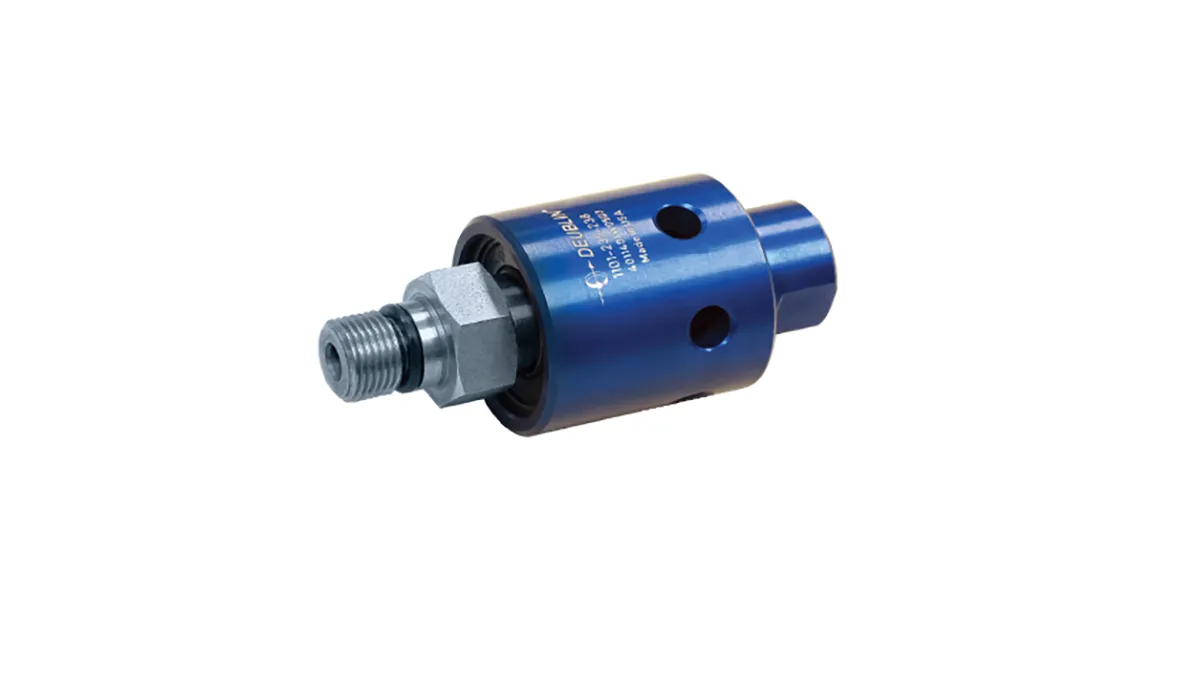
- Dimensional report against the OEM drawing for your part number — not a generic "fits Deublin 1102" claim.
- Pressure test record for the units being shipped, or a statement of the factory's 100% test procedure.
- Material declaration naming the carbon grade, silicon carbide grade, elastomer compound, and body material.
- Rating at your duty — max pressure and max speed at your operating conditions, stated in the confirmation.
- Seal kit part number confirmed in stock, so the union stays serviceable after installation.
- Certification documents — ISO 9001 factory certificate and CE documentation where applicable; ask for copies before payment.
- Counterfeit disclaimer — the supplier states in writing that the part is an aftermarket replacement, not affiliated with or endorsed by Deublin. A supplier that refuses this statement is telling you what they actually sell.
- Sample-first plan — order one unit for a critical machine, measure and fit-test it, then release the bulk order.
What You Actually Save
Typical retail comparison across the catalog: genuine Deublin units run $135-399 depending on series and size, while compatible replacements run $58-188 — a 2-7 times price gap. On the popular small single-passage models, expect roughly $135-190 genuine versus $58-95 compatible, about 40-70% per unit. Steam and multi-passage units show the same percentage with bigger absolute dollars: a $399 genuine steam union against a $188 compatible one saves over $200 per unit before volume pricing.
The total program saving is where it compounds. A plant with 30 machines × 12 unions × a 2-year replacement cycle, at 50% average savings, keeps five figures a year in the maintenance budget. Volume buyers can negotiate further on mixed containers — and because the popular series are the ones factories stock, the lead-time saving is usually as valuable as the price gap.
Service life parity is the condition for real savings. If the replacement lasts as long as the genuine part, the saving is pure. If it lasts half as long, you break even. That is why the material and verification checks above matter more than the price — and why the 10-20% derating question belongs in the first conversation, not after the first failure. Browse the Deublin replacement range to see the series and price points.
Risks, Derating & Warranty Terms
- Envelope mismatch: threads or length off by a few millimeters → machine modification or forced piping. Mitigation: confirm dimensions against the OEM drawing before ordering, sample-first on a critical machine.
- Wrong seal material: NBR in steam service fails in weeks. Mitigation: give the supplier your temperature and media, and get the elastomer compound in writing.
- Under-spec bearings: cheap bearings shorten life at speed. Mitigation: specify precision ball bearings and check the speed rating at your duty.
- Counterfeit branding: some sellers mark aftermarket parts as genuine. Mitigation: buy from factories that state "aftermarket replacement, not affiliated with Deublin" in writing.
- Derating: compatible parts are typically rated 10-20% lower in maximum speed and pressure than the OEM part at the same life target. If your duty sits near the OEM limit, ask for the compatible rating at your duty in writing. Running a derated part at the OEM limit shortens life — the failure will look like a quality problem but is a sizing problem.
- Warranty terms: an aftermarket warranty typically covers defects in materials and workmanship for a stated period, and excludes wear items and seals once the unit is in service. Read the clause before payment: what is covered, for how long, and what evidence (photos, test records) is required to claim. A one-line "12-month warranty" with no terms is not a warranty.
Disclaimer: replacement unions are independent aftermarket parts. They are not affiliated with, endorsed by, or sponsored by Deublin. The Deublin name and part numbers are used for cross-reference only. Verify all dimensions and ratings against the OEM drawing for your model before installation, and confirm the supplier's warranty terms cover your use before ordering.
Quick Answers
Is a Deublin replacement union the same as genuine?
No — it is an aftermarket part built to the same dimensional envelope and ratings. It is not affiliated with Deublin, but it installs and performs like the original when the seal materials and ratings match your duty.
Will a replacement void my machine warranty?
Check your machine builder's policy. In most plants, the union is a consumable or maintenance item, not a warrantied core component. Confirm with your maintenance contract before fitting aftermarket parts.
Which Deublin series are most commonly replaced?
The D-1000, 1100, and 1200 single-passage families and the 1102-070-079 type models, plus D-2000 and D-5000 steam series on dryer and paper machines.
How do I find my Deublin part number?
It is stamped on the union nameplate. If worn, measure the shaft thread, housing connection, body diameter, and overall length and send them to a supplier for identification.
How much can I save?
Typically 40-70% per unit on popular models, and up to 85% on the largest steam units, with service life parity when seals and materials match your duty. The catalog-wide price gap is 2-7 times.
What if my duty is near the OEM pressure or speed limit?
Ask for the compatible part's rating at your exact duty in writing. If it is 10-20% lower than the OEM rating and your duty is at the limit, move up a size or keep the genuine part for that position.
Are replacement unions certified?
Reputable factories hold ISO 9001 and can provide CE documentation on request. Ask for copies before payment — a factory that cannot produce its own certificate is not a factory.
Buy Deublin-Compatible Replacements Direct
Send your part number and duty — we confirm the envelope against the OEM drawing, publish the ratings at your operating conditions, and ship sample-first from the factory. No machine modification, no distributor markup.
NEXT STEP
Ready to Spec the Right Rotary Union?
Send us your requirements — our team responds within 24 hours with pricing and lead time.
Written by
LOOP ENGINEERING TeamRotary union engineering specialist. LOOP ENGINEERING helps machine builders and maintenance teams source factory-direct rotary unions.